


Among the Madonie Mountains in Sicily, one of the rarest and most fascinating products of the island’s heritage is still made today: manna. This precious resin-like sap, once dried and solidified under the summer sun, becomes a naturally sweet, delicate, unmistakable ingredient. Manna is ancient, rich in history, tradition, and symbolism, and deeply connected to the land where it originates. There is nothing quite like it anywhere in the world. Its production survives only thanks to the dedication of a few skilled artisans and the unique environmental conditions found in the Madonie area.
What is manna?
Manna is a natural sap that solidifies after being extracted from ash trees, mainly Fraxinus angustifolia and Fraxinus ornus. The sap flows from small cuts made on the tree trunk, and when it meets the hot summer air, it quickly hardens into white sticks known as “cannoli di manna”. It is an extremely pure and delicate product, easily recognizable for its light aroma and refined sweetness—never sharp or overpowering like regular sugar. Its greatest secret? The territory where it is born.
A true local product: the unique environment of the Madonie
The Madonie are the only active production area for manna in Italy. This is no coincidence: the region offers a rare combination of environmental factors that are nearly impossible to replicate elsewhere. Dry winds help the sap solidify quickly. Limestone-rich soils provide minerals that influence the tree’s metabolism. And the bright, dry Sicilian summers are essential for achieving the perfect yield and texture. Manna is therefore a strongly identity-based product: it exists only here because only here nature makes it possible.
Taste and Aroma
Manna stands out for its extraordinary sensory profile: a soft, subtle sweetness with light vegetal notes that remain clean and never intrusive. Its aroma is gentle, and in its pure form it has a crumbly texture, while in processed forms it dissolves easily. On the palate it feels elegant and never cloying. It is a sweetness that feels “light,” making it perfect for enhancing creams, desserts, drinks, and even cosmetic products.
Traditional production: an ancient craft
Harvesting manna is a meticulous job that requires skill, patience, and precision. At the beginning of summer, producers in the Madonie make small diagonal cuts (ntacche) in the tree trunk, allowing the sap to flow slowly along the bark. As soon as it is exposed to the sun, it begins to solidify, forming the characteristic white “cannoli.” The manna is then carefully collected by hand, piece by piece. It is a completely artisanal process: nothing is industrial, and nothing can be rushed. It is a direct relationship between human hands, the tree, and the climate.
History, traditions and legends
Manna has been known since ancient times. Greeks, Romans, and Arabs used it both as a sweetener and for its natural properties. During the Middle Ages, it was stored in apothecaries and considered a valuable product. Between the 18th and 19th centuries, it was exported across Europe, while in the 20th century it nearly disappeared due to the gradual abandonment of rural life.
In the Madonie, summer harvesting was almost ritual: master harvesters waking at dawn, entire families involved, and the whitest cannoli carefully preserved like treasures.
Legends were inevitable. Many locals considered manna a sacred gift, linking it to the “biblical manna.” And the artisans who extracted it, thanks to the delicate nature of their work, were almost seen as alchemists capable of “making the trees speak.”
Our Manna-Based Products
Manna is an incredibly versatile ingredient, which is why we have included it in a wide range of products designed to highlight every nuance of its flavor: from manna powder to manna flakes, as well as creams, biscuits, beer, and traditional Sicilian herbal liqueurs made with manna. We have even introduced cosmetic products made with manna into our shop, such as shower gel and soap.
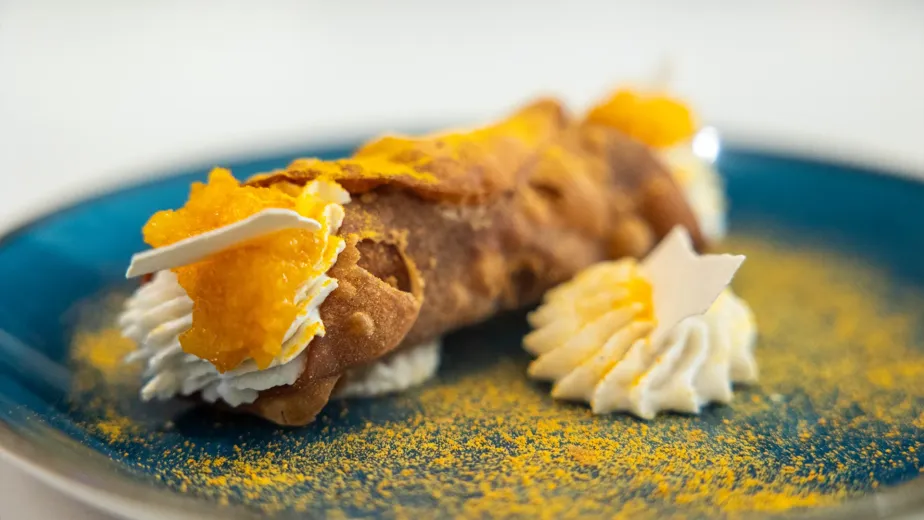
And for those who visit our bistro in Palermo, there is an unforgettable experience waiting: the chance to taste our manna cannolo. Instead of sugar or traditional ricotta sweetness, manna provides a refined, elegant taste and helps avoid sharp glycemic spikes thanks to its mannitol content, naturally less impactful on metabolism. But how was the manna cannolo created?
We entrusted our manna to our chefs, asking them to create a cannolo that respected tradition while using manna as the main sweetener. It wasn’t easy. Manna dissolves differently than sugar, reacts poorly to high temperatures, and requires a perfect balance of moisture. But after many attempts, our chefs found the ideal formula. The result was a glossy, smooth cream with a flavor unlike anything else—perfectly paired with the classic crunchy shell of the traditional Sicilian cannolo.
If you want to discover the authentic manna of the Madonie and taste products you won’t find anywhere else, visit our online shop.
And if you are planning a trip to Palermo, come and visit us at our bistro!